Monday, June 18, 2012

Hollow Gravity


The Hollow Gravity LP is now available to pre-order. There are only 100 copies - and as you would expect from Puer Gravy the pressing is on 180 gram vinyl with etched labels and screenprinted sleeves. So much for the packaging is the music any good?  Well you can try before you buy as Side 1 of the LP is available as a free download here

A reviews of Hollow Gravity by Jerry at Aural Innovations can be found here and by Edwin Pouncey from  the Wire magazine, September 2012 as below.

Philip Sanderson, electronic musician, installation artist, co-founder of Storm Bugs and founder of underground British tape label Snatch Tapes, returns with Hollow Gravity, a beautiful slab of vinyl with laser etched labels that flicker gently on the turntable as the disc rotates and the sounds pulse. This latest solo release from Sanderson follows 2005's album Seal Pool Sounds, a melancholic portrait of zoos that was also spiced with a mischievous erratic humour. 

Hollow Gravity is sombre but still playful, as Sanderson bolts together an imaginary science fiction soundtrack with his collection of analogue synthesizers, delay pedals and any other electronic junk that comes to hand from the pile. The results are zany and mysterious, occasionally flecked with a hint of menace, a sense of danger, a boiling vat of electronic music that occasionally sounds like the work of a mad scientist. 

The A side carries echoes of The Los Angeles Free Music Society, kicking off with an infectious robotic dance track that could have been penned by Doo-Dooette Dennis Duck. This moves into snatches of eerie spoken sound collage, giving the mood of a sonic séance as disembodied voices crowd in and fade away on Sanderson's synthesized ethereal plane. On the second side the darkness that has been slowly brewing finally closes in, leaving the listener marooned on an alien electronic planet tense with symphonic atmosphere.

Thursday, May 24, 2012

Funking the Phantom


To vaguely coincide with the imminent release of the Hollow Gravity LP on Puer Gravy, Daniel Blumin at WFMU has kindly asked me to record a session for his Saturday night radio programme (to be broadcast on June the 9th - see at the end for full details).  The 5 tracks revisit some of the ideas and techniques I used in the Reprint project recorded back in 1980 (originally released on cassette under the name of Claire Thomas & Susan Vezey and then re-issued on CD in 2006 by Anomalous). 

As with Reprint the recordings for this session were made using a deceptively simple set-up comprising: an analogue sequencer, a synthesizer and a 2-6 second delay system. The 8-note sequencer plays simple patterns but as they are fed into the long delay the beats begin to multiply and soon busy percussive rhythms start to emerge.
Long tape based delay systems were first used by Terry Riley back in the 1960s. Two tape recorders are employed – set a few feet apart with the tape stretching across the room from one machine to the other. The first machine records whilst the second plays back. This produces a delayed signal but by then passing this audio feed back to the first machine a feedback loop is created in which whatever is played into the system repeats ad infinitum or more commonly fades away after many repeats.

Riley called his system a ‘Time Lag Accumulator’ and used it for long pieces such as “Poppy Nogood and the Phantom Band” in which he would build up a layers of bubbling tones over which he would improvise.  The delay system with its feedback loop is the “Phantom Band”.
 Tape delay was brought to a much wider audience by Brian Eno who used it in both in his two collaborative LPs with Robert Fripp and on his own 1975 LP Discrete Music. On the cover of the latter Eno helpfully included a diagram. Inspired by this and what I had read about Riley in 1976 I built my own tape delay. I found some cheap domestic tape machines at the local market which ran at 1 7/8 inches per second, this meant it was possible to get very long delays even within the confines of a small bedroom, it also meant that the sound degraded very quickly. 
An aspect of tape delay not highlighted by Eno is that whilst it can be regarded as a generative system it is also a degenerative system in that each time a sound goes round the loop it is coloured by the characteristics of the equipment being used. If a sound is echoed/repeated say 100 times one is in effect recording and playing it back that many times, in other words to use the old analogue tape terminology it is 100th generation. The frequency response, noise and hum levels, wow and flutter of the equipment are thus magnified (in this example by a factor of 100). Using a high end tape machine like a Revox the degradation is relatively slow (though arguably still integral – more of which later) on the cheap domestic machines I was using back in 1975 the sound would relatively quickly break down into white noise something which seemed an interesting and potentially exploitable characteristic.

By 1978 having now accees to Revoxes, VCS3s and a sequencer I began to experiment with exploiting both the noise potential and rhythmic possibilities of tape delay. That Riley called his ‘Time Lag Accumulator’ a ‘Phantom Band’ may have been a reference to the semi autonomous nature of delay systems; specifically that once set in motion they seem to have a mind of their own. Delay and player easily get locked into a particular almost pre determined grooves that are both absorbing and hard to escape.  What often happens is that the player will hit a first note, wait for it to repeat to get a sense of the delay timing, then adds a second note, wait for that to return and then add two more in a counter rhythm and so on. All very pleasing but also after a while predictable.  Using a sequencer can potentially allow one to force the ‘Phantom Band’ to play numbers it might no want to, to in other words funk the phantom.

This was the basic premise of the two long electronic tracks on the Reprint cassette. Additionally rather than simply connecting the output of the playback tape recorder to the input it was fed through a graphic equalizer thus allowing one to accentuate the colouring and sound shaping aspects of the delay system. In both “Reprint 1” and “2” (hear MP3 of Reprint 2 here) this is used to encourage the degeneration of the sound; beginning with minimal rhythms and building into a wall of percussive white noise resulting in a sound not unlike tap dancing or stalactites falling in an underground cave.  

So much for the history why revisit Reprint?  Well partly as this was a session rather than music for an LP I wanted a method that was live, direct and improvisatory. Something one could do in one or two takes or with minimum of overdubs and editing. There was also a sense of unfinished business. “Reprint 1” and “2” were arguably successful in dislocating the ‘Phantom Band’s’ natural sense of rhythm but I thought it might be interesting to see what with a little more time and contemporary equipment could be conjured from the system. There is also something about the nature of echo. When we hear an echo our perception is of something receding, moving away from us and decaying. Paradoxically though the repeated sound travels not backwards in time but forwards into the future, it lingers on after the original sound has gone. It is the past coming back to haunt us. So in revisiting Reprint there is a double recuperation of old ghosts; firstly of the sound itself in the delay system and of a project echoing back from 1980 to the present.

Daniel Blumin’s show is broadcast on WFMU on Saturday nights between 9 PM and Midnight. In the UK this means the show airs five hours later between 2 and 5 AM on a Sunday morning. Never fear though there are of course playlists and podcasts available. The Sanderson session will be played on the evening of June the 9th (New York) meaning the morning of June 10th (UK).

Track Listing
01 intro
02 Running Rigging
03 A Blue Twist
04 Before the Mast
05 Marks and Deeps
06 An End

Monday, April 09, 2012

Die Cut LP Cover

Spontaneous Combustion were an English psychedelic band whose sound was probably about five years too late to be successful but their 1972 die cut LP cover with its crumpled inner sleeve design is a marvel.
Bolan would do something similar for Dandy in the Underworld about five years later. 

Monday, April 02, 2012

Radio Receiver

Missed the recent Rammel Weekender gig in Nottingham? Thought it might have been your only chance to hear Storm Bugs for another 30 years? Well fear not this Tuesday April 3rd tune in between 10.30 and 11.30 to Resonance FM (104.4 FM in London or on line here) to hear Storm Bugs play live on the ABJECT BLOC Radio Show with Tim Goldie. The plan is to play our recent Rammel set but as there is less time just speed up slightly (rather like going from 33 to 45 RPM). There you have at then Storm Bugs on 45 on your radio..

Sunday, March 18, 2012

Rammel Weekender

So - reels of tape, their flaky iron oxide particles only just adhering to the backing were set in motion, fragile electronic circuits with crackling pots and leaky capacitors were plugged in and found to be still working (just), beards were trimmed, corsets tightened, throats cleared - in short the Bugs were back
The band (sorry twinset), which had scarcely if ever, played before was on the road. The tour bus long since turned into a home for nesting birds was out of commission so it was Jimmy Saville all the way to Nottingham for the Rammel Weekender. 
At 9.30 we find ourselves on stage working our way through a set including Car Situations, Dull Sound of Breath, Windowshopping and other tracks that in some parallel universe were Greatest Hiss.
We sang, knobs were twiddled, audio files were looped and treated, far too much delay was applied to everything and in just 30 minutes it was all over and the New Blockaders were on. I was stretchered off with a shoulder injury leaving Prof Cheese to drink for both us.  Fuller reviews of the weekender can be found here (from which the Bugs pic above comes) and hereMore Bugs soon on your wireless.

Saturday, January 28, 2012

Thursday, January 26, 2012

Storm Bugs Live


Somewhat improbably Storm Bugs (as in myself Prof Jambon and Prof Fromage) will be performing Live in Nottingham in February. I say improbably as Storm Bugs were always more of a studio/bedroom band than a live outfit. Nonetheless we shall be dusting down our back catalogue for full and frank renditions of classics such as: Eat Good Beans, Tin, Car Situations, Dull Sound of Breath etc, etc.

As Storm Bugs we performed an "AV set" in the basement of the now defunct Foundry a couple of years back but to be honest it was more of a Sanderson/Ball video collaboration with little relation to the original recordings or Storm Bugs sound. In practice then this Nottingham outing will be our first live set since 1980 when we performed (but only just) in Brenchley Gardens in Maidstone. So this will be a recuperation of an imaginary former live existence mediated by time and technology. Get your tickets here

Saturday, October 22, 2011

A Safe Substitute

A Safe Substitute the Storm Bugs’ magnum lo-fi opus originally released on Cassette by Snatch Tapes in 1980 is now available on red vinyl from Harbinger (cat no Harbinger 096).  Tracks from A Safe Substitute have appeared previously on compilations but this is the first time it has been released in its entirety - a faithful transcript of the Snatch Tapes cassette release complete with a scaled reproduction of the original sleeve artwork and full liner notes detailing the recording of each track.

Here are a few words on A Safe Substitute from the Mutant Sounds blog
‘…this is everything a fan of left field D.I.Y. song structure perversion (U.K. stylee) could hope for. Much of what's heard on A Safe Substitute (fragments of which would re-appear elsewhere) were generated from that great old British analog beast, the VCS3 synthesizer, a machine used to more tonal ends by the likes of Franco Battiato and Pink Floyd and here providing swaying pendulums of corroded bloop, greyscale warble and hollowed out rhythms triggered from filter fucked arpeggiations, upon which they graft passages of alternately morose and plangent song structure fragmentation.’

Hitchcock still by JS


Sunday, July 10, 2011

Analogized?

Any re-issue of an album from the 1960s or 70s will proclaim that it has been digitally re-mastered – the term (and indeed the prefix re- itself) implies both a return to and a revelation of something. There is an implication that through the process of digital re-mastering we might find again the elusive lost original. An original which existed at some point in the analogue past and in an analogue form. The digital promise is that through the act of transference from reel-to-reel tape to a string of bits we can travel back in time and our analogue original can be regained and preserved.

But did the analogue original ever truly exist or is it a mythical creation that haunts the re-mastering process always threatening to be revealed yet suitably unobtainable causing albums to be re-mastered not once but several times?

Let s don our white lab coats and take a look at the steps in digital re-mastering process. Firstly we must go to the vaults and take out the master tapes. The master tape would normally be large 10 inch ¼ inch reel to reel tapes recorded at 15 IPS (inches per second) and containing a two track recording. These recordings were usually mixed from (depending on the era) 4, 8, 16, 32, 64 and 128 multi-track tapes.

However there may well be more than one reel-to reel master. Until the late 1960s both a stereo and a mono master would be produced. The mono master would not simply be a mono mix-down of the stereo mix but a separate mix from the multi-track often with a quite different sound from its stereo counterpart. Whether stereo or mono a further reel-to-reel tape would be made from this ‘original’ master by the cutting room engineer as he adjusted EQ and levels in an effort to make the vinyl record sound as 'good' as possible. Cutting vinyl was (and is) something of an art and certain cutting engineers would be valued for their work in knowing just how much could be squeezed onto the disc. Porky’s Prime Cuts for example was the name given to work by the mastering engineer George "Porky" Peckham who was famed for cutting discs - for example Porky cut a number of the T.Rex hit singles of the 1970 such as Metal Guru (and indeed also the Table Matters EP by Storm Bugs).

So already the ‘original’ analogue master tape is becoming a shifting target. A digital transfer from the cutting engineer’s master might in theory sound more like the vinyl record but that then doesn’t take into account the degree to which a pressing can shape a sound. A cutting engineer may for example have boosted the treble in places (especially towards the middle of the record) which on the finished vinyl sounds fine but if transferred to digital would sound too bright and so on. Then there is the issue of hiss. Engineers in the pre-digital era spent considerable time trying to eliminate the background noise which any analogue system naturally produces. Digital technology has accustomed us to a hiss free soundscape and the advent of noise reduction hardware and plug-ins will tempt all but the most resolute to remove at least some of the hiss not to mention clicks, pops, crackle, hum and other analogue undesirables.

This all assumes that any version of the master tape is still in existence. Had the two track master been destroyed we could if we still had the multi-track tape mix the tracks once more. However a final mix down in the 1970s (before automated mixing desks began to appear) was often a very much an on the fly process with many hands on the mixing desk faders bringing different musical parts in and out as required throughout a song. Furthermore some effects such as echo and reverb might have been applied only at the mixing stage and so to recreate the sounds we would need to have the same effects units available and maybe in a similar way to the moving faders adjust them during the course of the mix. It soon becomes clear that replicating the original mix is going to be a far from easy task; we might approximate it but probably not reproduce it.

The re-mastering process then become not so much a one-off event as a series of séances in which the producer assisted by the latest algorithms and the finest new plug-ins attempts to make contact with the phantom original and call forth its presence - only for it to fleetingly appear before receding once more to the other side.

Saturday, July 09, 2011

Exorcism in Colour

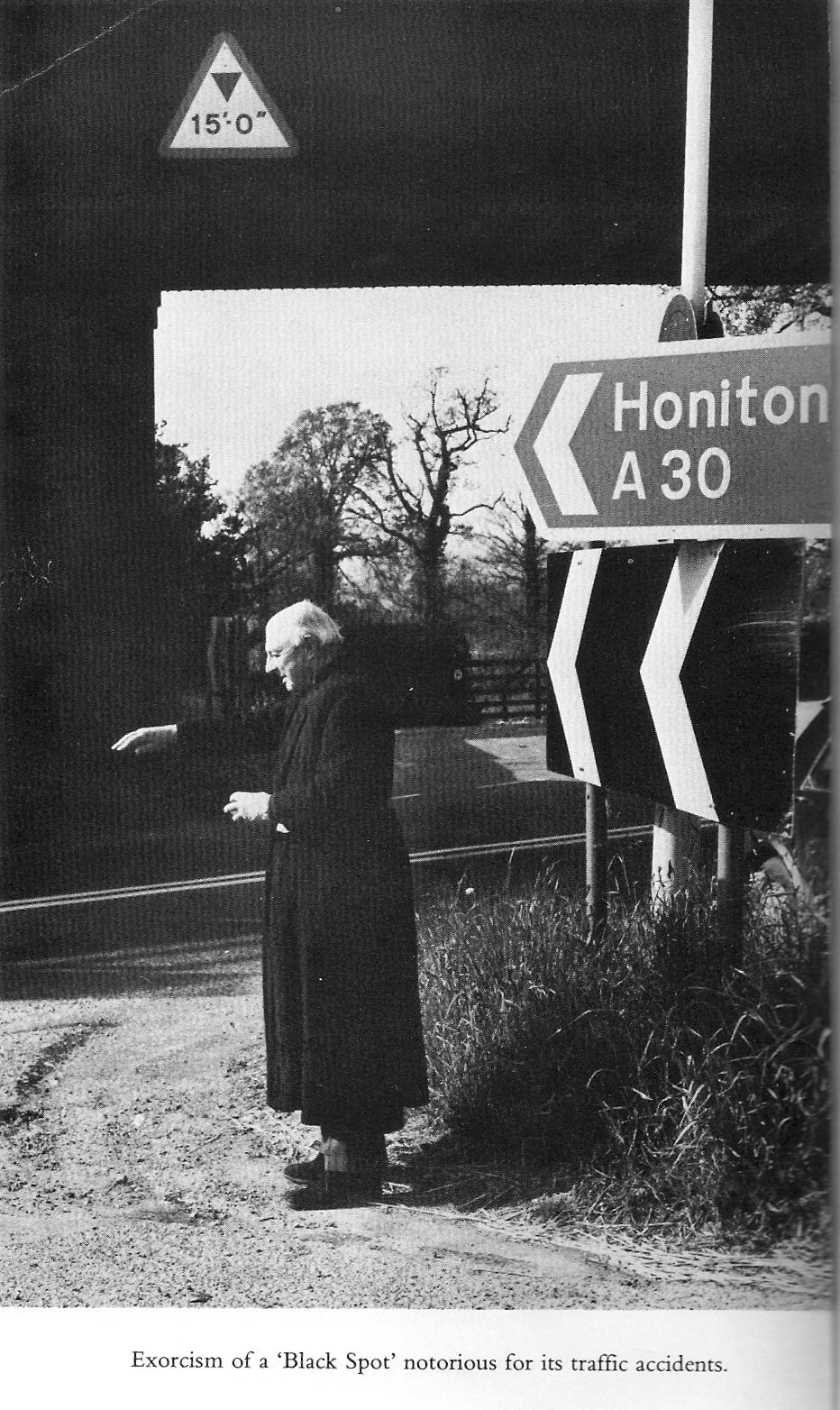
Can the hauntologogical be exorcised?
Adding colour by hand it was felt brought photos ‘to life’ though often as not the overall effect was often far from naturalistic or realistic and gave many pictures a somewhat other worldly quality. An analogy can be dawn with the clever handiwork performed in many an American funeral parlour whereby a sallow corpse is turned into a presenatable body an idealised frozen represntation to be viewed by the grieving relatives. In the case of the hand coloured photograph the tiny death (La petite mort) of the back and white image is replaced by a lifeless yet preserved colour image; set apart from the moment fixed (moment fixe).

Wednesday, July 06, 2011

Patinas of the Past

..arguably the boundaries between past and present are blurred such that there is an ongoing dialogue between the two. One might even imagine that the library and soundtrack music of the 1970s which so inspires the bands labelled as hauntological may not have been recorded in the past at all but could have been recorded now or indeed in the future and have simply seeped through the fluid pores of non linear temporality to physically manifest itself as piece of vinyl in the 1970s or as a download now or as who knows what at some future date.

Ah if only…..
 ‘Holding a battered copy of the Ziggy Stardust LP in one's hands, it can seem like a repository for nostalgic residues, as if the grooves in the vinyl were in some way the sculptured marks of time¹s passing.  Rather than let the sediments settle, the idea behind Suicide Suite was to create a means of once again setting in motion the sounds and images that have lain dormant since 1972.  Suicide Suite dose not aim to remix or add to the original but rather to create a ghostly twin; an echo of the LP that occupies a parallel but somewhat warped trajectory.‘

Through a Telephone Box Darkly

Sunday, July 03, 2011

Library Sale

As part of the American Ground festival in Hastings the library had a sale on - you know the sort - the ones in which they get rid of lots of interesting books to make way for popular autobiographies. Anyway I'm not complaining as I picked up some rather fine titles at 40P each. It occurred to me that if in a year's time you were strapped for cash and could not afford the new £9,000 university fees you could do worse than read these titles from cover to cover (total cost £3.20). Mind you my education was a little like that...


Wednesday, June 29, 2011

Secret Scuplture

In the 1960s and 1970s you might be forgiven for thinking that there wasn't much sculpture on TV - in fact there was a significant amount of subliminal sculpture by anonymous artists used as a backdrop behind bands and singers as they performed on TV shows. Echoing the contemporary sculptural forms of the day these often bold and yet unassuming works (they were never mentioned or acknowledged) have never been catalogued and are all but forgotten. Many no doubt had a short life span and some were probably destroyed after the performances in which they were used. Youtube (as ever) gives us an opportunity to revisit these works. Here are a couple of stills and an edited Barry Ryan video in which a rotating wire construction take up roughly a third of the on screen time.

Sunday, June 26, 2011

Touch and Play

Passing by the modernist toy shop of Paul & Marjorie Abbatt (2Bs and 2Ts) at 94 Wimpole Street I noticed Goldfinger carefully cutting out wooden letters, his Savile Row suit protected by a jute apron on which the small splinters of wood landed before being brushed towards the floor.
Stepping inside the toy shop to take a closer look at the merchandise I was approached by a nice lady in a blue cardigan who said ‘you may touch and play’. Goldfinger nodded and smiled adding ‘toys should be functional in design and educational in purpose”. I sensed though his mind was elsewhere, no doubt contemplating his big new commission at the Elephant & Castle.

Saturday, June 25, 2011

Modularity for Modern Living

The flexibility of the living space is derived from its modular construction in which numerous adjacent square and rectilinear sections can either be used independently as individual zones or combined together to form larger units as required.