Use the scroll bar on the right of your screen to scroll up and down quickly.
This blog is where works in progress by Philip Sanderson are posted along with thoughts on the moving image, sound, photography and anything else. Scroll down for an index of previous posts.
Thursday, June 23, 2011
Fewer frames make finer films - Contracted Cinema
Contracted Cinema – the reverse or, better still the inverse of expanded cinema.
In terms of defining that which we seek to invert namely expanded cinema, we could choose Gene Youngblood’s interpretation – a fluid liquid a go-go of art and life colliding as retinal consciousness which, for years had all the appeal of some bad hippy trip but now, in the age of media convergence seems timely and prescient. Alternatively we might prefer the English somewhat more sober focus on expanded cinema as involving the transformation of the spectator’s reception of the cinematic.
So contracted cinema then is the opposite of all that? In trying to achieve contraction we might try simple physical ploys like ensuring that all seats have a restricted view with pillars and obstacles between them and the screen or indeed we could take out the seats and make the audience stand to attention or slump against the wall. We might ensure that the sound is all but inaudible so audiences strain to hear over the amplifier hum or indeed we could crank up the volume sending the punters from the auditorium with ears bleeding. In terms of timing the contracted cinema programme should always begin before the audience arrives and end before they leave. But you protest, this is all too familiar, this is nothing new, your contracted cinema is what we already experience when we visit artist projections in the gallery; the black box in the white cube.
Bother - we need something less simplistic than just making life difficult for the audience or spectator. So contracted cinema could mean just less of everything; a sort of rationed cinema. Our slogan could be ‘Fewer frames make finer films’. To be fair though film stock was always so damned expensive that an excess of celluloid was rarely a problem it was video that could and often did go on and on. ”Cut out the bits you don’t need”. Sounds like a recipe for lo-fi. Should we be considering the material nature of the medium and how to foreground this, reducing everything down to the bare essence. Hell why not dispense with the whole paraphernalia (if we set light to it, it could be parafinalia) and just look out the window?
In terms of defining that which we seek to invert namely expanded cinema, we could choose Gene Youngblood’s interpretation – a fluid liquid a go-go of art and life colliding as retinal consciousness which, for years had all the appeal of some bad hippy trip but now, in the age of media convergence seems timely and prescient. Alternatively we might prefer the English somewhat more sober focus on expanded cinema as involving the transformation of the spectator’s reception of the cinematic.
So contracted cinema then is the opposite of all that? In trying to achieve contraction we might try simple physical ploys like ensuring that all seats have a restricted view with pillars and obstacles between them and the screen or indeed we could take out the seats and make the audience stand to attention or slump against the wall. We might ensure that the sound is all but inaudible so audiences strain to hear over the amplifier hum or indeed we could crank up the volume sending the punters from the auditorium with ears bleeding. In terms of timing the contracted cinema programme should always begin before the audience arrives and end before they leave. But you protest, this is all too familiar, this is nothing new, your contracted cinema is what we already experience when we visit artist projections in the gallery; the black box in the white cube.
Bother - we need something less simplistic than just making life difficult for the audience or spectator. So contracted cinema could mean just less of everything; a sort of rationed cinema. Our slogan could be ‘Fewer frames make finer films’. To be fair though film stock was always so damned expensive that an excess of celluloid was rarely a problem it was video that could and often did go on and on. ”Cut out the bits you don’t need”. Sounds like a recipe for lo-fi. Should we be considering the material nature of the medium and how to foreground this, reducing everything down to the bare essence. Hell why not dispense with the whole paraphernalia (if we set light to it, it could be parafinalia) and just look out the window?
Tuesday, June 21, 2011
English Vernacular
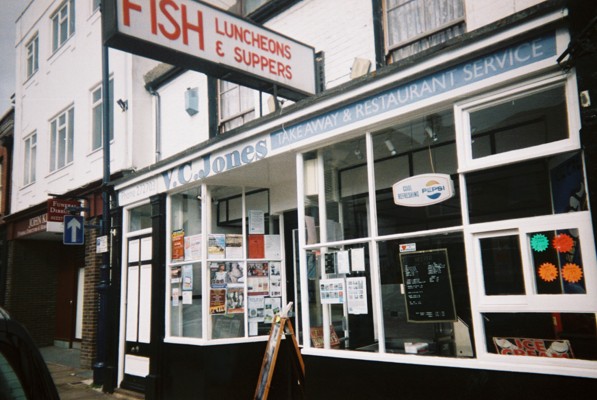
Whitstable doesn't have any grand buildings or architectural masterworks it does however have a lot of good old English Vernacular as per this example. For no particular reason I had a go at sketching the building which was slightly tricky as it was raining and I was standing up holding the pad in one hand and attempting to draw with the other - oh and I hadn't done any sketching for quite a few years. Excuses aside it did demonstrate almost straight away how much more of a building you 'see' when you draw it rather than photograph it if only as you repeat the action of looking back and forth from the building to the paper having for a split second to memorise what you have just seen and then reproduce or interpret it. Clearly I will be signing up for the summer water colour and drawing school.
Monday, June 20, 2011
Spotting and Foxing
1st edition, hardback with inscription on frontispiece. The pages are clean and bright although slightly yellowed. The cover is a little grubby with some staining. The corners and spine are bumped and worn. The spine is split in the middle and repaired. Damage from what looks like sellotape. The dust jacket is clipped with tiny closed tear to rear, slight bumping to illustrated boards, some spotting and foxing to endpapers and closed page. Ex library stock has a number of stamps throughout the book mainly on the back of the colour plates. Numbers written on first endpage, light shelf wear, showing signs of rubbing and marks, but still pretty neat. Early pages have a few pencil notes, though generally book is clean and very readable. A used second-hand book. Condition: Fair.
Friday, June 17, 2011
High Street
Spent a few days last week down in Whitstable. It had been some ten years or so since I was last there and though undoubtedly a little more touristy it still manages to avoid being like a novelty model village. The high street has working fishmongers, butchers, bakers, greengrocers, hardware shops etc all run independently, just as you used to find on any high street before the advent of the supermarket and which, you still find in most of mainland Europe (though yes I have heard the reports of Boulangeries closing at an alarming rate). It is not so much that one should be nostalgic for such times or romantic notions of ‘community’ but a working high street (and I would contrast this with the boutique foody artifice of Borough Market) just makes the quality of life so much better.
Thursday, September 30, 2010
Make Art History
As the Make Poverty History campaign falters and with the prospect of 25-40% cuts in the arts it seems far more likely that we can Make Art History
Thursday, September 23, 2010
Battle of the Pixels
Sunday, August 29, 2010
Sunday, May 16, 2010
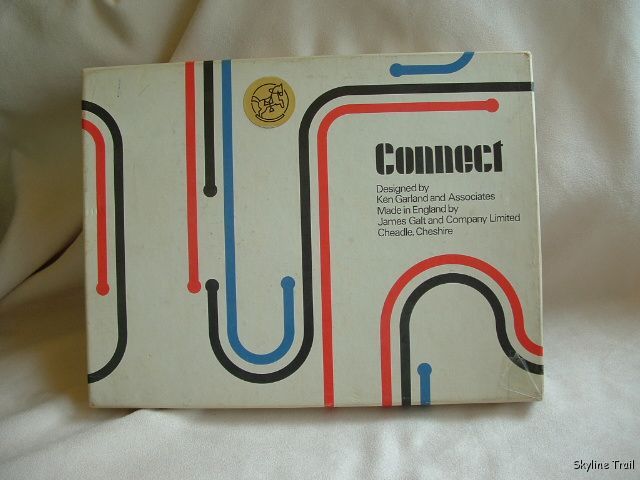
Connect by Ken Garland for Galt
Go down the aisle of a Toys R Us shop today and your senses are assaulted by sequences of brightly coloured and somewhat garish plastic toys all competing for your attention. Many have a quirky charm displaying something of a mutoid imagination at work but few would be seen as works of modern design. Yet for a period in the 60s two of Britain's leading toy makers Galt and Abbatt produced games, puzzles and jigsaws, which in their own way are perfect examples of high modernism. The best of these modernist toys is Connect designed by Ken Garland for Galt in 1969. Garland and Associates is a firm of graphic designers and they were originally asked to redesign Galt packaging and brochures. This Garland did with aplomb using what by today’s standards would be considered very muted tones and fonts.


Having designed the packaging Garland and Associates moved on to designing the some of the Galt toys themselves bringing contemporary 1960s graphic design values to the toys and a particular emphasis upon spatialization, sequencing and repetition.
Connect best embodies this comprised of 140 cards each with red, blue and black lines the game involves linking up the cards in style that owes something to dominos to create extended patterns that look for all the world like some minimalist artwork by Sol Lewitt or even in some ways Mondrian.
The game was designed to be played on the floor and to weave around household furniture and other objects. With its stark simplicity a whole generation of children where unbeknownst to them engaging in an early course in graphic design principles.
The rights to Connect were later licensed by the German toymaker Ravensburger and renamed Rivers, Roads & Rails. Unfortunately whilst the game still employs the same underlying principle the simple colored lines have been replaced by representational drawings and so loose its graphic simplicity and abstract edge.
Thursday, February 18, 2010
A funny thing...
When I woke up this morning at 5AM these lines popped into me head...
I have know you and loved you so long that
I no longer know where I end and you begin
said the romantic poet to his wife of many a year
She smiled sweetly both at his presumption
and for a moment seeing herself in the arms of Clarice Duff
the landlord’s daughter
Saturday, January 30, 2010
Now Close your Eyes
Lumiere et Son wonder if dance really is a pathway to cosmic consciousness particularly if you must close your eyes .
Saturday, January 16, 2010
Friday, January 08, 2010
Lo Fi - Screwing a ribbon between two circles

What with Radio 4's PM programme having a feature on the return of the cassette as art object it seems Lo-Fi is to be one of the themes for 2010. In which vein I was contacted late last year by a South American (Colombian to be precise) music magazine called Shock and interviewed on my opinions about analogue and Lo-Fi, Here follows a few short extracts from a transcript translation by Google.
Low-fidelity sounds you return the heat and dirt on the music scene that recalls, among cassettes and vinyl, an earlier time still has stories to tell. The analogue resurrected and promiscuous flirts with the mainstream, the underground and the new generations.
Philip Sanderson, who produced the record label independent Snatch Tapes, a label in the UK has been willing to resurrect the old formats of music, told Shock version of his own nostalgia. "The object, be it vinyl or cassette, has been too important in the history of music. They provide, together with the cover and liner notes, a visual dimension. An aesthetic and noise condition is lost with the downloads.
Sanderson, who in addition to producing music with his band makes Storm Bugs, one of the most legendary of DIY (Do It Yourself) in London, remembers well the little asepsis and the warmth of the old formats. "With an Mp3 file and you have nothing to what you can have fun a good time. The digital can be so clean and yet so cold I think we need to bring back some dirt and heat with similar productions and objects.
The method of producing a tape is much more complex than screwing a ribbon between two circles and is even harder if you want to make one carried by the spirit, power and the rawness of a production lo-fi. "That's not as silly specks," said Philip Sanderson, who really knows what he means to give life to a low-fidelity production pressed on this analog format. "In Snatch Tapes use many things and nowhere at the same time. We break speakers to create interesting distortions they propose other sounds to the melodies, voices and instruments; overprint tapes, we use the cacophony and noise from the environment to strengthen sound sequences. All of these techniques for very lo-fi twist and transform the sounds that eventually will rotate tangled cassette loops, "he says.
While manufacturing of one of these rectangles sound is an arduous process, its sale is a hell of work and underpaid. If hardly a music lover spends an average $ 1.29 to buy the latest hit from the iTunes Store worldwide, imagine how much would pay for the same song "bad settings" in a cassette.
According to Nielsen SoundScan, a system that collects data on sales of albums and singles in the United States in the first five months of 2009 vinyl sales rose 50 percent from those that took place in the same period last year . While for the vinyl everything is 'in crescendo', from sell 700 thousand in 2008 to 1 million in 2009 for CDs and digital albums will ruin everything, reducing its sales between this year and last in 30 million and 6 million respectively.
Juan Pablo Gallon | Shock.com.co
.
Labels:
Hearing Things,
Snatch Tapes,
Storm Bugs
Wednesday, December 23, 2009
Perfectly Rounded
In a very short space of time Lumiere et Son has established itself as a family firm with a reputation for quality and service and attention to detail. Here is an example of their most recent workmanship giving an insight into the creative process.
Monday, November 30, 2009
Letterboxing

Lumiere first met Son on a trip to England when studying a scene through a letterbox at the Barbican. The music that came to mind was naturally from Orrori del castello di Norimberga (Baron's Blood).
Monday, October 19, 2009
Twinset John & Edwad Grimes out of sync

Psychologists and sociologists have long had a thing about identical twins especially those separated at birth as they provide endless possibilities for studies that try to pinpoint the exact impact of nature versus nurture; of the role of genes on our development against that of the environment we are brought up in. In wider society there is also a certain fascination with twins; obsessed as we are in the west with individuality the idea that such singularity can effectively be duplicated throws so many assumptions into something of a tail spin. There is also an underbelly to our preoccupation with twins which is to see something essentially malevolent in their bond and unspoken telepathic rapport with their almost inbuilt ability to gang up on the poor lesser world of us mere individuals. The krays best epitomise this malevolence and it is no surprise that once finally convicted the twins were separated and sent to different institutions; one to Broadmoor the other to prison. To keep both twins in the same institution would have been simply too threatening.
All of these preoccupations find an unlikely expression in this year’s X Factor in the form of the twins John & Edward Grimes from Dublin. In the auditions Simon Cowell took an instant dislike to the twins describing them as vile and willing to trample their grandmother’s grave if it meant success. Cowell himself something of a bully and control freak clearly felt in some way threatened by these two 18 year Dubliners either recognising himself mirrored back (twice) or recalling some playground trauma. Louis Walsh though seeing boy band potential (and interestingly they are in the band category – are twins a band?) and no doubt recalling the short lived though highly lucrative (for their manager) career of Bros put them through to the live shows despite serious shortcomings in their singing. For the last two weeks then the Grimes have performed and despite being largely out of tune and a serious media campaign to have them booted off have remained on the show.
Whilst they survive their performances offer a curious spectacle. More able to dance than most of the contestants they nevertheless struggle to synchronise steps or for that matter vocals. Watching their performance is a little like having your own brain dissected as they constantly dart glance s from one to the other in an attempt to synchronise their routines. The truth seems to be that twins don’t naturally align their performances but offer a simultaneous rendition of two performances by the same artist. If we took any performer, for example Paul McCartney with all his various mannerisms and got him to perform a song twice and then synced up the two versions they would be very similar but annoyingly different. A previous precedent can be found in Barry & Paul Ryan who for a brief period in the 60s shared a stage before Paul retired to write the songs and Barry remained on stage to belt them out. Their shared performances are equally as off putting as those of the Grimes
The answer is perhaps curiously not to get twins to try and synchronise but to either be asynchronous or to echo or anticipate each other combined with odd flashes of synchronisation. It seems nether our brains or theirs can cope with anything else.
Subscribe to:
Posts (Atom)