Sunday, May 16, 2010

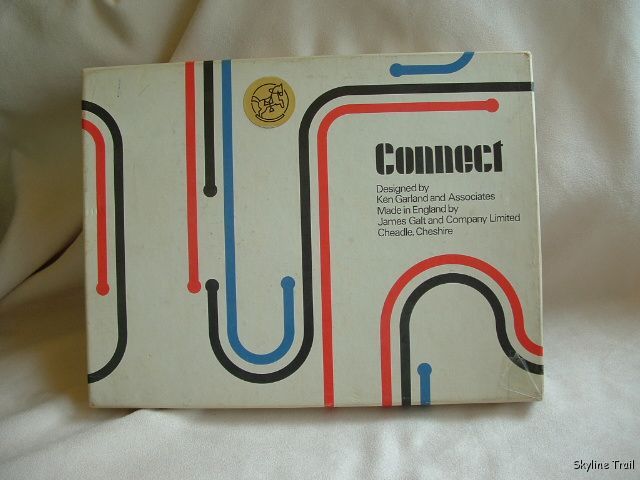
Connect by Ken Garland for Galt

Go down the aisle of a Toys R Us shop today and your senses are assaulted by sequences of brightly coloured and somewhat garish plastic toys all competing for your attention. Many have a quirky charm displaying something of a mutoid imagination at work but few would be seen as works of modern design. Yet for a period in the 60s two of Britain's leading toy makers Galt and Abbatt produced games, puzzles and jigsaws, which in their own way are perfect examples of high modernism. The best of these modernist toys is Connect designed by Ken Garland for Galt in 1969. Garland and Associates is a firm of graphic designers and they were originally asked to redesign Galt packaging and brochures. This Garland did with aplomb using what by today’s standards would be considered very muted tones and fonts. 


Having designed the packaging Garland and Associates moved on to designing the some of the Galt toys themselves bringing contemporary 1960s graphic design values to the toys and a particular emphasis upon spatialization, sequencing and repetition.
Connect best embodies this comprised of 140 cards each with red, blue and black lines the game involves linking up the cards in style that owes something to dominos to create extended patterns that look for all the world like some minimalist artwork by Sol Lewitt or even in some ways Mondrian.  
The game was designed to be played on the floor and to weave around household furniture and other objects.  With its stark simplicity a whole generation of children where unbeknownst to them engaging in an early course in graphic design principles.
The rights to Connect were later licensed by the German toymaker Ravensburger and renamed Rivers, Roads & Rails. Unfortunately whilst the game still employs the same underlying principle the simple colored lines have been replaced by representational drawings and so loose its graphic simplicity and abstract edge.  

Thursday, February 18, 2010

A funny thing...

When I woke up this morning at 5AM these lines popped into me head...

I have know you and loved you so long that
I no longer know where I end and you begin
said the romantic poet to his wife of many a year
She smiled sweetly both at his presumption
and for a moment seeing herself in the arms of Clarice Duff
the landlord’s daughter

Saturday, January 30, 2010

Now Close your Eyes


Lumiere et Son wonder if dance really is a pathway to cosmic consciousness particularly if you must close your eyes .

Saturday, January 16, 2010

Overseen Overheard


Lumiere et Son are troubled by patanormal activity in which voices seem detached from the body

Friday, January 08, 2010

Lo Fi - Screwing a ribbon between two circles


What with Radio 4's PM programme having a feature on the return of the cassette as art object it seems Lo-Fi is to be one of the themes for 2010. In which vein I was contacted late last year by a South American (Colombian to be precise) music magazine called Shock and interviewed on my opinions about analogue and Lo-Fi, Here follows a few short extracts from a transcript translation by Google.

Low-fidelity sounds you return the heat and dirt on the music scene that recalls, among cassettes and vinyl, an earlier time still has stories to tell. The analogue resurrected and promiscuous flirts with the mainstream, the underground and the new generations.

Philip Sanderson, who produced the record label independent Snatch Tapes, a label in the UK has been willing to resurrect the old formats of music, told Shock version of his own nostalgia. "The object, be it vinyl or cassette, has been too important in the history of music. They provide, together with the cover and liner notes, a visual dimension. An aesthetic and noise condition is lost with the downloads.

Sanderson, who in addition to producing music with his band makes Storm Bugs, one of the most legendary of DIY (Do It Yourself) in London, remembers well the little asepsis and the warmth of the old formats. "With an Mp3 file and you have nothing to what you can have fun a good time. The digital can be so clean and yet so cold I think we need to bring back some dirt and heat with similar productions and objects.

The method of producing a tape is much more complex than screwing a ribbon between two circles and is even harder if you want to make one carried by the spirit, power and the rawness of a production lo-fi. "That's not as silly specks," said Philip Sanderson, who really knows what he means to give life to a low-fidelity production pressed on this analog format. "In Snatch Tapes use many things and nowhere at the same time. We break speakers to create interesting distortions they propose other sounds to the melodies, voices and instruments; overprint tapes, we use the cacophony and noise from the environment to strengthen sound sequences. All of these techniques for very lo-fi twist and transform the sounds that eventually will rotate tangled cassette loops, "he says.

While manufacturing of one of these rectangles sound is an arduous process, its sale is a hell of work and underpaid. If hardly a music lover spends an average $ 1.29 to buy the latest hit from the iTunes Store worldwide, imagine how much would pay for the same song "bad settings" in a cassette.

According to Nielsen SoundScan, a system that collects data on sales of albums and singles in the United States in the first five months of 2009 vinyl sales rose 50 percent from those that took place in the same period last year . While for the vinyl everything is 'in crescendo', from sell 700 thousand in 2008 to 1 million in 2009 for CDs and digital albums will ruin everything, reducing its sales between this year and last in 30 million and 6 million respectively.

Juan Pablo Gallon | Shock.com.co
.

Wednesday, December 23, 2009

Perfectly Rounded


In a very short space of time Lumiere et Son has established itself as a family firm with a reputation for quality and service and attention to detail. Here is an example of their most recent workmanship giving an insight into the creative process.

Monday, November 30, 2009

Letterboxing


Lumiere first met Son on a trip to England when studying a scene through a letterbox at the Barbican. The music that came to mind was naturally from Orrori del castello di Norimberga (Baron's Blood).

Monday, October 19, 2009

Twinset John & Edwad Grimes out of sync


Psychologists and sociologists have long had a thing about identical twins especially those separated at birth as they provide endless possibilities for studies that try to pinpoint the exact impact of nature versus nurture; of the role of genes on our development against that of the environment we are brought up in. In wider society there is also a certain fascination with twins; obsessed as we are in the west with individuality the idea that such singularity can effectively be duplicated throws so many assumptions into something of a tail spin. There is also an underbelly to our preoccupation with twins which is to see something essentially malevolent in their bond and unspoken telepathic rapport with their almost inbuilt ability to gang up on the poor lesser world of us mere individuals. The krays best epitomise this malevolence and it is no surprise that once finally convicted the twins were separated and sent to different institutions; one to Broadmoor the other to prison. To keep both twins in the same institution would have been simply too threatening.

All of these preoccupations find an unlikely expression in this year’s X Factor in the form of the twins John & Edward Grimes from Dublin. In the auditions Simon Cowell took an instant dislike to the twins describing them as vile and willing to trample their grandmother’s grave if it meant success. Cowell himself something of a bully and control freak clearly felt in some way threatened by these two 18 year Dubliners either recognising himself mirrored back (twice) or recalling some playground trauma. Louis Walsh though seeing boy band potential (and interestingly they are in the band category – are twins a band?) and no doubt recalling the short lived though highly lucrative (for their manager) career of Bros put them through to the live shows despite serious shortcomings in their singing. For the last two weeks then the Grimes have performed and despite being largely out of tune and a serious media campaign to have them booted off have remained on the show.

Whilst they survive their performances offer a curious spectacle. More able to dance than most of the contestants they nevertheless struggle to synchronise steps or for that matter vocals. Watching their performance is a little like having your own brain dissected as they constantly dart glance s from one to the other in an attempt to synchronise their routines. The truth seems to be that twins don’t naturally align their performances but offer a simultaneous rendition of two performances by the same artist. If we took any performer, for example Paul McCartney with all his various mannerisms and got him to perform a song twice and then synced up the two versions they would be very similar but annoyingly different. A previous precedent can be found in Barry & Paul Ryan who for a brief period in the 60s shared a stage before Paul retired to write the songs and Barry remained on stage to belt them out. Their shared performances are equally as off putting as those of the Grimes

The answer is perhaps curiously not to get twins to try and synchronise but to either be asynchronous or to echo or anticipate each other combined with odd flashes of synchronisation. It seems nether our brains or theirs can cope with anything else.

Monday, August 03, 2009

Only For Pleasure


Only for Pleasure.
Note takes a moment or two to load. In Safari if after loading you get the QuickTime question mark, just hit refresh in the browser and the file should start to play. In Firefox file will play after loading. Not tested on IE.

Monday, July 20, 2009

Sound Projector Railway Special


This Friday you are invited to take your seats aboard the Sound Projector Radio Show railway special. Your footplate DJs Ed Pinsent (Driver) and Philip Sanderson (Fireman) will be playing a selection of sound and music inspired by and derived from the railways. This one off special will leave from the Resonance FM sidings at 5.30 sharp and the round trip will take 1 hour and 30 minutes. After returning to the sidings there will be a chance for refreshments later at a local hostelry. Update: an mp3 podcast of the programme is now available here. The full playlist is here as well as the stanadalone podacast player.

Monday, July 06, 2009

Patamatic Cinema


Historically cinema has offered two opposing modes of reception, passive and active. In the passive mode we are swept along by the whole illusion of cinema; embedded in the narrative construct of seamless edits and musical accompaniment; we give ourselves up to the flow of the frames. Such is the stuff of Hollywood and popcorn. In the active mode the filmmaker keeps us restless in our seats by constantly re-asserting the illusion of representation. As viewers we are called to action; even if it is only to get up and leave our seats for whilst passive cinema can be a heady narcotic that leaves us ultimately drowsy and empty, active cinema can in the hands of some avant garde filmmakers pursue the denial of pleasure as almost a raison d’etre.

One form of active cinema that engages more than most is Expanded Cinema. Expanded Cinema draws attention to the act of projection itself by employing multiple screens and projectors, and a general level of performativity that involves projectionist/artist, space and audience. However the term Expanded Cinema (originally coined by Stan VanDerBeek) is quickly acquiring something of an historical edge, rather in the same way that happening or environment are connected to the heady days of the 1960s. Increasingly Expanded Cinema conjures a world of clattering projectors and mid to late twentieth century equipment, filmmakers and aesthetics.

As a concept though Expanded Cinema has an ongoing relevance particularly as a potential paradigm for video on the web. Watching a streamed movie file is everything conventional cinema isn’t. Rather than being in the dark often as not we are in a brightly lit room. Instead of sitting back in a well upholstered chair we are sitting upright no more than three feet from the screen watching a screen that far from enveloping us is often filled with text and other potential distractions. Most importantly of all we not at the mercy of the projectionist we can start, stop and move between files and perhaps consequently rather than being 90 minutes long most online movies are 2-3 minutes in duration.

All of these factors can either be seen as problems to be solved or as potentially fertile ground to be explored. The success of YouTube has demonstrated an appetite for the making and viewing of short movies on the web and indeed has created something of a cinema of spectacle but the potential both for a democratization of film production and distribution and for the emergence of some new form of expanded cinema has so far yet to be fully realized.

As is often the case the more interesting attempts to create an expanded web cinema are occurring at the margins. One such project is Spacetwo : Patalab. At first glance Patalab might seem like just another video blog with its almost daily postings of short works. In Spacetwo however there is a subtlety and complexity to the works that in part is underpinned by the maker’s undivided preoccupation with the seemingly unremarkable. Its is the nuances of space and time and of attention lavished on things that are perhaps designed not to be looked or that seek out obscurity that that elevates these everyday musings to a heightened poetic state. Patalab is as an ongoing project with seemingly no declared beginning, middle or end has echoes of Marcel Proust’s work and its continual obsessive return to the same territory, to the same places spaces and thoughts and the passage through them and back again.

Nearly all of Patalab’s video are shot hand held tracing simple steps through buildings and rooms. We move slowly up flights of stairs, down corridors along walls, pondering details as we go; a stack of chairs, an open window, a cornice or skirting. Occasionally legs and feet emerge in front of the camera as do overhead voices on the soundtrack but these are not voodles about people but about the resonance of space. Building day after day these two to three minute works create a library or repository of images from which the viewer can draw or withdraw. There is a willful denial of narrative progression and the audience is called upon to realize that they are re-tracing their own steps; going back to the same familiar passage. Forced to confront everything again till eventually seeing it all for the first time.

Into this charged space seeps the text for, all the Patalab voodles ( a contraction of video and doodle) are laced with quotes; quotes and passages from a variety of sources including philosophers artists, scientists, poets, religious thinkers. Enigmatically removed from their original context the text and ideas float on the browser page before leaking slowly into the videos. Nether obscuring or informing the quotes and links are tangential to each other and to achieving a strong sense of deconstructed purpose. A context of possibilities, open endings and beginnings; again echoing both Proust and the more absurdist Alfred Jarry Patalab is a rich source of endeavor that demands repeated viewings.

Thursday, June 25, 2009

Vested Interests


Just a very short time ago, it seemed we were at the end of something and the beginning of …well no one quite knew but post crash everything was definitely going to change wasn't it? With the most enormous of financial bubbles burst and the now flaccid little pieces of the balloon stuck to the sides of our mouths we all stood in awe of the devastation and vowed that everything would be different. We shook our heads at our collective foolishness and greed and pondered our debts and how we might possibly repay them.

But the vested interests are not so easily deterred. Having been bailed out by the taxpayer to the tune of billions the city after the briefest of periods of contrition is back to paying out big bonuses. Never mind that a generation has effectively been robbed of its pensions, if the new RBS chairman can get the share price up to 70P then the government can cash in and sell its shares in the bank at a profit and supposedly wipe out some of the enormous public debt that threatens to dog us for the next 50 years. In other words the mechanism that broke the system is being restarted with some vain hope that it can now fix the very problem it caused.

Over in the art world it’s much the same as Tate Britain opens Classified an exhibition featuring the work of some very familiar names: Damien Hirst, the Chapman Brothers, Martin Creed, Tacita Dean etc. Curator Andrew Wilson says of the work, "I sincerely believe that this art is amongst the best work that has been made in the last 15 years or so." Of course Tate has invested heavily in these artists in so many ways and it was highly unlikely that they would leave the pieces mouldering in the Bricklayers Arms depot but have they no new tricks to play, nothing else up their sleeves but the same old fandango? It would seem not, “who knows” they no doubt muse privately perhaps the exhibition will remind us all just how good these artist are and help get the art market bus back on the road as well and the champers will flow again and the bankers and artists can once again mingle at the Frieze art fair tent whilst the poor sucker public pick up the tab.

Update 2012: Well whilst three years on the UK economy continues to be in recession the Art Market after a brief dip has bounced back. Despite the populace loosing their collective shirt the super rich go from strength to strength and these are of course the people who can afford art.  

Friday, June 12, 2009

Last Few Days


The No Particular Place to Go exhibition is on for another week. During this time the gallery is open by appointment but will also be open from 2-4 PM on Saturday and Sunday the 20th and 21st. On Sunday there will also be a screening at 3PM of recent videos by yours truly.

Still Running


For the screening last Saturday various works in progress were "finished". Here then is Still Running

Wednesday, June 03, 2009

No Particular Place to Go

 
No Particular Place to Go Exhibition ran from: 7th June to 21st of June 2009 Memorial Art Gallery,  Hastings.

Press Release: Criminally underrated, fly-tipping displays all that is best in contemporary sculpture. Combining a range of media, fly-tips can rival early Bruce McLean or Anthony Caro in their inventive composition. At ease in both rural and urban landscapes these seemingly effortless public art works stand out in any location. In No Particular Place to Go Philip Sanderson has selected photographs of fly-tips from all over the UK. The photos were taken and uploaded by numerous people to the Geograph British Isles project; a website that aims to collect photographs of every grid square of the British Isles and make them available under a creative commons licence. Using this pool or raw images as a starting point Philip Sanderson has assembled the fly-tip photographs into a video. Using a custom digital process each photo was scanned to produce a musical note. Putting the images together a musical sequence emerged; a pastoral accompaniment to the images. No Particular Place to Go presents the resulting video on discarded TVs which together with hand selected detritus form a fly-tip installation. Each fly-tip’s location, grid reference, and the name of the photographer is identified on an index card displayed on the walls of the Memorial Gallery. The installation can be viewed at the Private View at the Memorial Gallery Hastings on the 6th of June 2009 and thereafter for two weeks by appointment. During the Private View there will be a thirty-minute screening of recent videos by Philip Sanderson including Product Recall, Fleshtones, and examples from the Chronocut series.