Thursday, October 04, 2007

Sound Projector Radio Show - Update


The forthcoming issue of Sound Projector magazine, which will be available later this year, has an interview with yours truly covering all things Snatch Tapes, Storm Bugs and other sound and vision issues. This Friday (the 5th October) there is also a chance to hear my dulcet tones when I join Ed Pinsent on his Sound Projector radio show on Resonance FM. Expect to hear some previously unaired material from the Snatch archives as well as the odd Storm Bugs fave, some new tracks and a selection of fine numbers by non Snatch artists including demonstration records, crackly flexidisks and more. Tune in tomorrow on FM in London or on line anywhere else between 5.30 and 7 PM.

Update - A full tracklisting and podcast of the radio show is now available at the Sound Projector site. Note: scroll to the bottom of the tracklist for the podcast.

Monday, July 02, 2007

Hand Held


Today - a new hand held chameleon communication device that responds to touch by synthesising thought processes into co-ordinated colours. See a 30 second demonstration here

Wednesday, June 27, 2007

Waterborn


Inspired by watching Sam's patalab ripples late last night I whipped out my digital brsuh and spalashed on some watercolour for a very very quick widescreen sketch of my own. Nods of course to Sam, Maziere's Red Sea and all the other waterborn babies. See the watery grave here

Sunday, June 24, 2007

Product Placement (A Love Story)


We are pleased to announce a unique new premier product for that milestone once in a lifetime occasion such as an anniversary, birthday, wedding or as a one off gift for someone special. The product is made of an alloy glass and onyx compound that changes shape to fit the wearer and the occasion. One moment it is a ring the next a ceremonial dagger; it is wahtever the wearer desires. View a prototype sample here.

Wednesday, June 06, 2007

Supplementary Benefit -Update Video


Out today on Vinyl on Demand. is the latest re-issue of vintage Storm Bugs material. Matured in oak vats for over 25 years these fine recordings have a full body and a sharp prickly aroma reminiscent of carbolic and cinnamon. More precisely side 1 of the LP comprises full length versions of the the first two Storm Bugs singles; namely the 5 track Table Matters EP (1980) and the Metamorphose single (1981).

Whilst tracks from these singles have appeared on compilations before, this is the first time they are being presented in their entirety. This means the first re-issue of the spoof industrial rockabilly track Tin and the vocal version of Make Customer Matter. The tracks have been digitally re-mastered from virgin un-played copies of the two discs.

If side 1 displays Storm Bugs's infamous post punk DIY sound with much use of scratched vinyl, disemboweled radios and home made electronics, side 2 of the LP contained tracks made exclusively with the unique british synthesizer the VCS3. The VCS3 has a matrix pin patch bay in which any module can be connected to any other module, resulting in complex feedback loops and unexpected modulations. The VCS3 tracks which include Hodge, Slip Slap and Hiemal (And She Blew) are all taken from original Snatch Tapes cassette releases. This is the first time most have appeared on vinyl, and of course this means the full heavy weight VOD vinyl we have come to know and love. 

VOD 44 Storm Bugs "Supplementary Benefit" LP
Side 1
Cash Wash: 1.41
Eat Good Beans: 1:59
Make Customers Matter: 2.09
Window Shopping: 2:06
Our Main Objective: 4.44
Car Situations: 3:20
Tin: 2.54
Aboulia 19: 1:06

Side 2
Hodge: 6:41
Slip Slap: 1:36
Hiemal ( And She Blew): 4.51
He Rose Up Again: 3:08
Slow Along the Wire: 1.24
Blackheath Episode: 4.44

Thursday, May 24, 2007

Kisser


In which Marilyn Monroe goes up in smoke.

Tuesday, April 17, 2007

Immediate Cinema


The term camera is a shortening of the Latin camera obscura (literally dark room), and at its very basic the camera is just that, nothing more than a windowless room with a small pinhole onto the world outside. Light passes through the hole and forms an upside down two-dimensional image on the back wall of the room.

In its simplest state the camera obscura is if you will a form of immediate cinema, an immediate cinema that has dispensed with all the apparatus of complex lenses, shutters, film, projector and so on. There is no script or direction above and beyond the placement of the pinhole; the cinema makes itself, free from edits and other manipulations and human interventions. There is in this immediate cinema a continuity of temporal expression a durational equivalence tempered only by the most momentary of delays, namely the speed of light.

This immediate cinema can only be seen live, in real time, every screening is a one off never to be repeated. All screenings are in full colour with what in the video world would be called full frame full motion. The camera obscura is reflexive about its representative mechanism. That the image is upside down is in itself a declaration of the origins of the light. This then is a pro-illusion device.

If only we could leave it at that. If only we could let the light waves disperse and die of their own accord. Instead the trajectory of camera making has been all about how best to fix the fleeting image on the back wall. Like trying to pin down and classify some elusive wild animal the immediate cinema of the camera obscura is problematised by our desire to in some way capture the image.

The earliest form of capture was simply pencil and paper. Rather than make hand eye estimates of the shape and position of things, by using the camera obscura seemingly highly realistic details could be recorded by artists. Without entering the debates as to whether Caravaggio used the camera obscura on this or that painting it is clear that from the renaissance onwards artists began to use the device as an aid. In a sense photo realist painting was being practiced several hundred years before its invention.

Photography proper merely simplified the process of tracing the fleeting image. Place some suitably light sensitive paper on that back wall and it will map the play of light for as long as the pinhole remains open. If the light sensitive paper is suitable processed and fixed we will have a representation of the fluctuating light during the pinholes opening. These pinhole pictures with their long exposures blur the moving and leave the stationery clearly defined. As records of a given duration and the attendant density of light accumulation they again have a refreshing pro-illusional quality.

Replace the pinhole with a complex lens and faster more responsive emulsion and we begin to enter the nightmare that is modern stills photography; all guile and deception and evacuation of meaning. For now both static and moving objects are arrested; as if a hand was at (literally) lightening speed tracing the outlines. Such images are rich in detail but poor in content.

Animate a series of such photographic stills and we have the makings of a cine camera. Such a camera/projector (all early devices where able to perform both functions) can in a limited way replay the magic of the obscura but introduces a whole new set of problems. Gone is the immediacy, gone is the live transmission and the temporal equivalence, and gone for the much of the 20th century was the colour. No longer happy with the continuity of light itself we begin to tinker with cuts and edits. Compressing and cutting out what is seen as unnecessary and extraneous time.

The camera itself is progressively shrunk and mobilised; no longer stationery it starts to dance and dive, taking close ups, medium shots and all the narrative suggestion that framing involves. As the essential meaning of the immediate cinema of the obscura starts to evaporate we clamour to assign new meanings to the rapidly evaporating medium. The self-proclaimed pro-illusional of the obscura is replaced by anti-illusion of the materialists on the one hand and by the suppressed illusion of Hollywood on the other (not to mention all those stumbling blindly somewhere in between).

Wednesday, April 04, 2007

Radio Snatch Tapes


In a previous blog entry I recall bemoaning the state of UK radio; in particular how outside of London there is usually nothing more than the 4 BBC channels and a couple of commercial stations. Radio 4’s news and current affairs coverage is good but music-wise Radios 1-3 rarely step too far from the mainstream. Elsewhere in the world in particular in North America there is whole network of college radio stations who play an eclectic mix of material; often everything from country to industrial with interesting factual programmes mixed in. Programmes may be initiated by one station and then played on several others. It is on such a network that lucky late night listeners could hear in the wee small hours of this morning a Snatch Tapes special put together by Rory Hinchey of Collective Voice. The special comprises choice Snatch cuts from the original tapes and re-issues interspliced with extracts from a fairly lengthy interview I did with Rory last week.

The Collective Voice Podcast in downloadable .mp3 format will be posted to http://www.collectivevoice.net on Saturday, May 5, 2007.

Friday, March 09, 2007

Picture Motion - Some Thoughts on Illusion

Update of posting first made in August 2005

Just as with the smoke and mirrors of Pepper’s Ghost or the magician’s routine, early cinema began life as something of a self-professed "trick". This was not a cinema of narratives in the Hollywood sense but of the grande spectacle as Tom Gunning notes (1988) film ”was less a way of telling stories than a way of presenting a series of views to an audience, fascinating because of their illusory power”

Early cinema’s location as part of the sideshow or as traveling attraction gave its illusory qualities an in-built reflexivity. Like all tricks (however good) cinematic illusion required the audience’s complicity. The sleight of hand of the cardsharp who momentarily distracts the audience’s attention whilst he slips the ace of diamonds behind his ear was replaced by movement of claw and shutter dragging the next frame into place. By conjuror’s standards film’s routine was crude and simple, in effect a black curtain was being drawn between frames but the degree of complicity was the same. Particularly at slow film speeds you must want to perceive continuity between frames and create for yourself the illusion of movement. In foregrounding illusion; even celebrating it, early cinema was not so much anti-illusionist as pro-illusionist; an active engagement with the inherent trick of cinema itself.

The degree of complicity required is somewhat at odds with the commonly held view (amongst public and film theorists alike) that the perception of motion in cinema can be attributed to persistence of vision; a physical phenomenon located in the eye. Advocates of persistence maintain that either there is a build up of images on the retina similar to the after trace experienced when looking at a moving bright light (a sparkler for example) or that some form of fusion takes place in the eye.

This defect of the eye long since disproved by psychologists is still regularly offered as an explanation for the moving image experience by film theorists. Indeed so ingrained has the theory of persistence of vision become that it is almost taken for granted. AndrĂ© Bazin (1967:19) for example remarked almost in passing that “the persistence of the image on the retina had been known for a long time.”

An effort to enlighten the film community about scientific developments in understanding "persistence of vision’ was made by Joseph and Barbara Anderson in 1978. Seemingly having little impact on what they describe as the myth of the persistence of vision the couple tried again in 1993 with "The Myth of Persistence of Vision Revisited".

The unwillingness of the film community to take on board the Anderson’s resume of developments in the scientific community may stem from the unwieldy nature of some of the terminology used. Put simply they describe two processes called short-range and long-range apparent motion. The illusion of the perception of motion in film falls within the first category and is not retinal but a function of the whole visual perception processing function of the brain. Short-range apparent motion is then not a passive process in which the eye is involuntarily tricked by film into perceiving motion its is an active perceptual system. In other words we the viewer are actively engaged in making the series of individual frames into a continuity of motion, we make the illusion happen.

Our complicity in engaging with and willingly seeing illusion repositions the viewer as participant rather than simply a dull and unwitting receptor in the cinematic experience. Without an active viewer there is no motion picture just a series of stills.

Complicity implies a level of active participation and in the sense that the viewer creates for himself or herself the picture motion (it is not on the screen) then they are actively engaging in the filmmaking process. But has the viewer the free will to stop seeing the illusion? As with magic tricks where one can train oneself to see the sleight of hand, the possibility that a viewer could learn to see the "reality" of the individual frames is tantalising though untested.

The Anderson’s annoyance (1978) with the film community for continuing to advocate "the myth of the persistence of vision" rests less perhaps on a proclamation of the audience’s complete free will than on a subtle shift of emphasis from the eye to the brain. "The concept of a passive viewer implied by the myth must be replaced by the viewer implied by an enlightened understanding of the illusion: a meaning-seeking creature who engages the film as actively as he engages the real world about him" [and with specific regard to certain strands of film theory] "psychoanalytic-Marxist film scholars have retained the model implied by persistence of vision: theirs is a passive viewer, a spectator who is ‘positioned’, unwittingly ‘sutured’ into the text, and victimised by excess ideology" In effect the Anderson’s are empowering the viewer and making them a far more active part of the process.

The complicity and mutual acceptance of illusion by both filmmaker and audience paradoxically gave early cinema a transparency (a transparency based on what is not seen rather than what is), which in its development as Hollywood narrative medium has gradually been erased. This is not to say that issues of depiction, representation and illusion have not been the subject matter for a range of film theorists from the structural materialism of writers such as Peter Gidal to the feminist film critique of Laura Mulvey not to mention the psychoanalytic film theory of Lacann and Zizek.

Whilst disparate in their approach and conclusions what such theorists have in common is an acceptance of cinema's basic illusion as a sine qua non and the viewer almost as given. When Gidal (1989) for example is a talking about an anti-illusionist cinema he is referring to issues around the illusion of the depicted and the represented whilst seemingly ignoring the illusion of cinema itself which must surely first itself be dissected. Whilst resisting the supposedly implicit bourgeois tendencies of narrative the materialist project seems happy to accept the basic mechanisms of cinema.

This taking for granted or presumption of a basic condition of cinema not only closes off an important avenue of exploration and research but also seems to fall short as model for the interpretation of contemporary developments in moving image practice in particular to what is sometimes referred to as either artist film & video or digital media. In many ways these practices and their screening re-locations outside of the confines of the normal cinema and into the gallery return us to the earliest days of moving image and the side show and in so doing force us to reexamine rather than accept the basic cinematic process.

In this context it may be useful to think in terms of not one but many levels of illusion, all of which invite participation to a greater or lesser extent by the viewer. There is the essential cinematic illusion of movement (or its continuity across frames), then we have an illusion of representation (that what is depicted in some way represents something we may have seen outside the screen) and then an illusion of narrative, of some kind of sequential development, not necessarily linear or story telling in purpose but certainly time based. These different illusions should not necessarily be seen as hierarchical but as all occurring simultaneously and interdependently. In much narrative Hollywood film these illusion are traditionally suppressed (in other words complicity is demanded rather than invited) in pursuit of often straightforward literary and drama based story telling. However in classic anti-illusionist cinema polemics (if not always in the films themselves) the illusion of representation is problematised and the illusion of movement ignored and narrative declined. This approach serves to sever the link to Hollywood but does not result in a true materialist cinema but rather just a stunted one. A cinema in denial rather than one, which declares its pro-illusionist essentiality.

Update of posting first made in August 2005 - first two comments from origianl post

Tuesday, February 27, 2007

A Bit of a Scrape


Spent the weekend in the role of Professor Ham working alongside professor Cheese in snowbound Copenhagen helping facilitate a workshop with Sam from Patalab on video daydreaming. 

Initially I will admit to being a little cautious about the whole concept of daydreaming videos with their surrealist overtones. However as the workshop progressed it became apparent that the notion of an intuitive daydreaming video practice had much in common with the kind of Youtube work programmed for the recent Screen Dump Cog Collective screening. Work in which the transmission from spectacle to screen is keep as uncluttered as possible by overt intention and editing. 

One could almost describe this as an automatic process in which the emphasis is on, not looking for things to film but filming things to look at. This is a subtle distinction, but the former seems to result in pieces which are composed of a series of juxtapositions of “interesting” details; a composition of fragments influenced by the language of Bauhaus by way of Pierre Schaeffer whereas the latter is more about letting go and letting the everyday action create its own mis en scene. The shooting and framing of the first process was well described by one student at the workshop as making video doodles, which we truncated to the pleasing sounding term of Voodle. The second process could best be described as some kind of digital camera obscura. Anyway here is a small example of this automatic process.

Friday, December 08, 2006

Hair Today

A few years ago I made a picee called Rock n Roll Heart in which a female mannequin's head spun back and forth on a turntable, the hair gently lifting as it does in those hair product commercials. 

Here are a couple of looped snippets from such commercials, as time goes by the irritation ends and they start to phase in and out in a pleasing fashion. When you have seen enough click inside the frame and the movies will stop.

Thursday, December 07, 2006

Screen Dump - The Videos


Just over a month ago I compiled a screening of V-log work from YouTube and beyond for the Cog Collective. For anyone who missed it. or who was simply on the other side of the planet, links to all of the videos are now up on the CogBlog site. To simulate the screening experience you shoudl watch the pieces chronologically, though I did notice some nice interference occurs when you play more than one at a time.

Monday, November 27, 2006

Snatch Paste


Back in March I blogged about the imminent release of Snatch Paste, an LP on the Vinyl on Demand label containing an assorted selection of tracks from the three Snatch Tapes Compilations. Well the wheels of the industry can turn slowly but just in time for Christmas I can announce that the disc is now “out” and is a fine document of the more experimental end of the UK DIY tape scene between 1979 and 1981.

I received my copies at the weekend and as always for the first couple of plays was taken aback at just how different a vinyl pressing sounds to the audio master. Don’t get me wrong the record has been perfectly well cut and pressed (on heavy weight vinyl indeed) its just that all records sound different to the audio that went into them. Advocates of vinyl always point to its potential to reproduce a much wider frequency range than CD’s and of course that fully rounded bass sound. Both of these qualities do exist on playback but the medium is far from being a transparent one. When cutting the master the engineer often makes a number of on the spot sonic decisions in a bid to best squeeze on as much of the audio spectrum as possible without causing the cutting head to burst into flames. Its essentially a compromise as, to get 22 minutes on the side of the LP necessitates quiet a bit of audio ducking and diving. A 12 inch single gives just that much more room but in both cases (LP & 12 inch) the bass frequencies have to be drastically rolled off otherwise the grooves in the disc would be too wide to be playable. This is known as pre-emphasis and is a fixed equalisation curve applied to all discs. If you were to play the resulting LP back “as is” far from having a deep bass sound it would be incredibly tinny. However what happens is that the phono amp in every Hi-Fi has an equalization circuit in the pre-amp stage, which reverses the process that occurred in the cutting by boosting the bass. Over the years cutting engineers have learnt to ride this process and make records that are good re-presentations of the original tape or sometimes even sound much better, but a transparent copying process this is not.

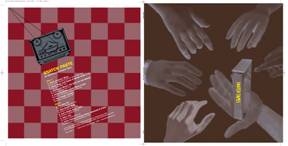
So in the Snatch Paste LP we have a pleasing paradox; a series of recordings made for cassette release some 25 years ago, recently digitised and now played back through the medium of vinyl with all its nuances and colors. The end result is like some audio sonar bouncing back a quarter of a century to some murky marine bed of ferric experimentation and then forward to the present day via bit and stylus. Oh and if you make this one of your desert island discs you get the added bonus of being able to use the back of the sleeve as a chess board!

Monday, August 07, 2006

Skypoint


The QuickTime player seems to have trouble with files in avi format but nevertheless tries to open them. The result is a series of flickering colouring squares at the top of the screen that seem in some way to relate to the soundtrack of the film, though precisely how is unclear. Using the max/msp/jitter matching mole patch it is possible to decode these pictures and produce a new soundtrack which whilst sounding nothing like the original in some way follows its digital contours and outlines. Herethen is Skypoint a flamenco flavoured reworking of the Pink Floyd promo movie for Point me at the Sky. (Note QuickTime 7 for Mac or PC required).

Thursday, July 27, 2006

domestique electrique


Before Claire Thomas & Susan Vezey were defrocked so to speak there were plans afoot for a follow up tape to Reprint. Unlike Reprint which was largely tape delay based the new work was to employ small fragments of sound from the domestic interior amplified and then looped and re looped, speed changed, treated, re looped and so on. The sound sources ranged from the electrical hum of the kitchen fluorescent to the static crackle made by a pair of denier nylons. A number of long almost drone like recordings were produced in 1981 in my flat in Deptford indeed the bedroom at the time was missing a mattress but had a number of nails banged in the wall on which hung all the loops (I used to sleep on the sofa in the living room) . The project even had a couple of provisional working titles including domestique electrique and deshabille electronique (that’s electronic undress en francais of course).

Given Cherry Red’s reluctance to pursue further releases with Claire & Susan once their identities were revealed the project was eventually abandoned and the tapes lost or destroyed. However in going through the archives for the various snatch re-issues some small fragments from the original sound sources were found along with a few notes for the project and so it was possible to reconstruct many of the tracks.

Two of these reproductions were included on a bonus CDR released with the 25 copy limited edition Box set (as in a box) of the Seal pool Sounds CD last year.